AI App Development
AI App Development: A Complete Guide from Concept to Production


Artificial intelligence has changed software development by completing tasks like writing boilerplate code, creating documentation, testing features, and building prototypes much faster. It does not replace developers but helps them spend less time on repetitive work and more time solving real business problems.
This guide explains the complete AI app development process, including the core technologies behind AI apps, where they provide the most value, and how development teams use them to build faster, safer, and production-ready applications.
What Is AI App Development?
AI app development is the process of building applications that use artificial intelligence to perform tasks that usually require human thinking. Developers use pro-code, low-code, no-code platforms, and AI-powered tools to make development faster and more efficient.
AI apps use technologies like machine learning, large language models, natural language processing, computer vision, and data analytics. These technologies help automate tasks, personalize user experiences, and generate useful insights from large amounts of data.
Core Features of AI Applications

- Intelligent AI capabilities: AI-powered applications integrate technologies like NLP, machine learning, predictive analytics, and computer vision to perform complex tasks intelligently.
- Workflow automation: By automating repetitive and manual processes, AI apps help organizations save time, reduce errors, and improve overall productivity.
- Personalized user experiences: AI analyzes user behavior, preferences, and interactions to provide customized recommendations, content, and services.
- Insight-driven decision making: AI applications process and analyze large datasets to identify patterns, predict future trends, and support informed business decisions.
Popular AI Application Examples
- Virtual assistants: Digital assistants such as Siri, Alexa, and Google Assistant use natural language processing to understand voice commands and provide accurate responses.
- Image recognition applications: Solutions like Google Photos and facial recognition systems rely on computer vision to detect, classify, and organize images automatically.
- Generative AI platforms: Applications such as ChatGPT use large language models to create content, answer questions, and engage users in natural conversations.
- Predictive analytics tools: AI-enabled financial applications analyze historical and real-time data to forecast market trends and deliver personalized investment recommendations.
AI App Development Process
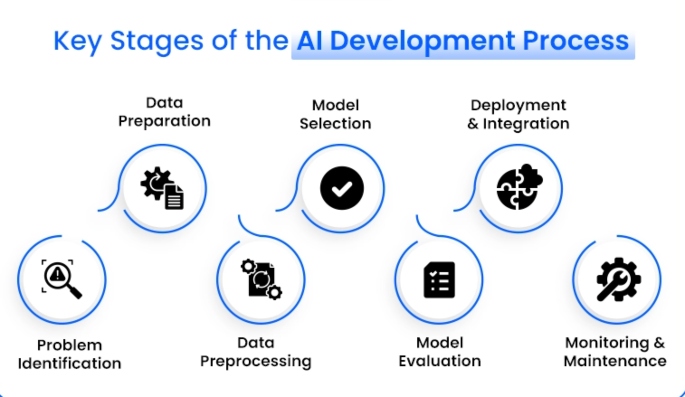
- Define the objective: Identify the problem your application will solve and establish clear development goals.
- Collect and prepare data: Gather, clean, and organize the data needed to train and support the AI model, if custom model training is required.
- Ensure data security and privacy: Build strong security measures and privacy protections into the application from the beginning to safeguard sensitive user information.
- Select appropriate development tools: Choose the most suitable pro-code, low-code, no-code, or AI-powered development platforms based on the project’s complexity and requirements.
- Launch and continuously improve: Test the application thoroughly before deployment, then monitor its performance, collect user feedback, and make ongoing improvements to enhance functionality and accuracy.
Why AI Is Transforming Modern Application Development
Software development includes repetitive tasks like writing similar code, fixing bugs, updating documentation, reviewing code, writing tests, and maintaining systems. These tasks are important but do not create a competitive advantage.
AI coding assistants can generate boilerplate code, explain code, suggest improvements, detect bugs, and create unit tests. This reduces repetitive work while developers focus on architecture and business requirements.
AI speeds up development by handling much of the groundwork. Features that once took days can often be completed in hours, while developers review and refine the final results.
Businesses benefit from faster releases, earlier bug detection, consistent documentation, and the ability to manage larger projects without significantly increasing team size.
AI supports the entire software lifecycle. It helps summarize requirements during planning, assists with coding and debugging during development, creates test cases during testing, and improves legacy code during maintenance.
AI also makes it easier to understand large codebases. Developers can use natural language to quickly find features, APIs, or functions instead of manually searching through files.
AI-powered design tools can generate layouts, recommend accessible colors, create UI components, and build prototypes from simple text descriptions, giving designers a strong starting point.
Overall, AI has shifted software development from repetitive coding toward creative problem-solving and innovation.
Core AI Technologies Behind Intelligent Applications
Artificial intelligence is not one technology. It is a collection of related technologies that work together to solve different types of problems.
Understanding these building blocks helps you choose the right approach for your application instead of assuming one model can solve everything.

Machine Learning
Machine learning allows software to improve by learning from data instead of relying only on manually written rules.The model studies examples, identifies patterns, and uses those patterns to make future predictions.Suppose an online retailer wants to predict which customers are likely to make another purchase.
Rather than writing hundreds of rules, the business can train a machine learning model using previous purchases, browsing history, product categories, and customer behavior. The model gradually learns which combinations of factors lead to repeat purchases and uses those insights to predict future outcomes.
Machine learning powers many everyday applications, including:
- Fraud detection
- Product recommendations
- Spam filtering
- Predictive maintenance
- Demand forecasting
- Medical diagnosis support
- Credit risk assessment
As more high-quality data becomes available, these systems often become more accurate over time. The quality of the training data remains one of the biggest factors affecting performance. Even sophisticated models struggle when trained with incomplete, outdated, or biased information.
Natural Language Processing
Natural Language Processing (NLP) helps computers understand human language by analyzing context, grammar, meaning, and relationships between words instead of treating them as separate terms.
NLP powers applications like chatbots, voice assistants, spam filters, translation services, and search engines that understand conversational language. Large language models have made NLP more advanced, allowing users to receive explanations, summaries, recommendations, and even code from simple language prompts
For businesses, NLP helps automate customer support, analyze feedback, summarize documents, process contracts, and improve knowledge management.
Generative AI
Generative AI creates new content instead of simply analyzing existing information. Depending on the model, that content may include:
- Text
- Images
- Software code
- Audio
- Video
- Reports
- Documentation
- User interface designs
- Generative AI has become a key part of modern AI app development. It can generate code, create product descriptions, build interface prototypes, and draft personalized customer responses from simple text prompts.
- Its biggest advantage is speed, allowing users to start with a strong first draft instead of creating everything from scratch. users begin with a solid first draft that can be reviewed, edited, and improved. That review step remains essential.
- However, human review is still essential because AI can produce incorrect information, outdated code, or responses that lack business context. Combining generative AI with reliable data sources helps ensure accurate, secure, and high-quality results.
AI Agents
AI agents take generative AI a step further by planning tasks, making decisions, using tools, maintaining context, and completing multi-step workflows instead of responding to a single prompt. In AI app development, they automate complex processes while keeping humans involved in important decisions.
For example, an AI agent can receive a customer request, search internal documents, retrieve account details, generate a personalized response, create a support ticket, schedule a follow-up, and notify the right team—all within one workflow.
Modern AI agents can:
- Reason through complex problems
- Remember previous interactions
- Call APIs
- Use external tools
- Work with structured data
- Follow predefined guardrails
- Request human approval when needed
These capabilities make AI agents valuable for customer support, business automation, research, software development, and operational workflows.
Retrieval-Augmented Generation
Large language models have broad knowledge but do not automatically know your company’s internal information. Retrieval-Augmented Generation (RAG) solves this by retrieving relevant documents from a trusted knowledge base before generating a response.
For example, if an employee asks about vacation policies, a RAG-powered application retrieves the official HR policy and generates an answer based on that document instead of relying only on general knowledge. This produces more accurate, up-to-date, and verifiable responses.
A typical RAG workflow includes:
- Preparing and storing documents in a searchable vector database.
- Retrieving the most relevant information for a query.
- Generating a response using both the retrieved content and the user’s request.
Because it reduces hallucinations and keeps responses aligned with trusted business information, RAG has become a core technology in modern AI app development.
Fine-Tuning Models
Fine-tuning customizes how an AI model behaves for a specific task. Unlike RAG, it does not add new company knowledge, it adjusts the model’s style, tone, formatting, and behavior.
For example, organizations can fine-tune models to:
- Follow a formal legal writing style.
- Format healthcare summaries consistently.
- Use approved customer support communication guidelines.
Fine-tuning is ideal when consistent behavior is required across thousands of interactions, especially when prompt engineering alone cannot deliver reliable results.
The three approaches serve different purposes:
- Prompt engineering improves instructions.
- RAG improves knowledge.
- Fine-tuning improves behavior.
Many production AI systems combine all three for the best results.
Common AI App Development Use Cases Across Industries
AI app development helps businesses automate work, improve customer experiences, and make better decisions. The greatest value comes from solving practical business problems that save time, reduce effort, or improve outcomes.
Personalization
AI analyzes user behavior to recommend products, movies, news, and other content based on individual preferences. This improves user experience while increasing engagement, retention, and sales.
Predictive Analytics
AI helps organizations anticipate future events instead of simply reacting to them. Common use cases include fraud detection, patient risk assessment, demand forecasting, and delivery prediction, enabling faster, data-driven decisions.
Natural Language Applications
Natural language AI powers chatbots, virtual assistants, document summarization, email classification, contract analysis, and language translation. Large language models improve these applications by understanding context instead of relying only on keywords.
Computer Vision
Computer vision enables applications to understand images and videos. Businesses use it for visual product search, quality inspection, medical image analysis, and security monitoring.
Process Automation
One of the biggest benefits of AI app development is automating repetitive work. AI can:
- Process invoices
- Categorize support tickets
- Moderate user-generated content
- Extract data from forms
- Schedule appointments
- Generate reports
- Detect suspicious transactions
By handling routine tasks, AI allows employees to focus on strategy, creativity, and decision-making.
The AI App Development Lifecycle
Successful AI app development follows a structured process that aligns technical implementation with business goals. Skipping key stages can lead to poor performance, security issues, or low user adoption.
Define the Problem and Success Metrics
Every AI project should begin with a clearly defined business problem rather than simply choosing an AI technology.
Examples include:
- Reducing customer support response times
- Increasing product recommendation conversions
- Automatically classifying support tickets
- Improving document search accuracy
Projects should also establish measurable success metrics, such as:
- Response accuracy
- Customer satisfaction
- Processing speed
- Cost savings
- Conversion rates
- Error reduction
Clear objectives and measurable metrics make it easier to evaluate whether an AI application delivers real business value. Without measurable goals, it becomes difficult to know whether the application actually delivers value.
Prepare and Manage Data
Data is the foundation of successful AI app development. Even the best AI models cannot overcome poor-quality data, so teams spend time collecting, cleaning, organizing, and validating datasets.
This process typically includes:
- Removing duplicate records
- Fixing formatting issues
- Handling missing values
- Removing outdated data
- Labeling training examples
- Standardizing data formats
For RAG-based applications, documents are also cleaned, divided into smaller sections, converted into vector embeddings, and stored in searchable databases. High-quality data directly improves AI accuracy.
Build AI Logic and Application Workflows
After preparing the data, developers design how AI fits into the application. This involves more than writing prompts, they define the overall workflow.
Key decisions include:
- Selecting the right AI model for each task
- Writing effective prompts
- Connecting external APIs
- Managing data flow
- Deciding when human review is required
- Handling errors
Many AI app development projects use AI agents to automate workflows. For example, a customer support assistant can read a request, search documentation, retrieve account details, draft a response, request approval if needed, and update the CRM automatically.
Train or Configure AI Models
Not every AI app development project requires training a custom model. Many applications use pre-trained models enhanced with prompt engineering, RAG, or fine-tuning.
The right approach depends on the use case:
- Prompt engineering provides better instructions.
- RAG adds current business knowledge.
- Fine-tuning improves tone, formatting, and specialized behavior.
Choosing the simplest effective approach reduces both development time and maintenance costs.
Test, Evaluate, and Add Guardrails
Testing AI applications goes beyond checking whether the software works. Teams must ensure outputs are accurate, reliable, and safe.
Evaluation typically measures response accuracy, quality, clarity, factual correctness, and consistency using test datasets with known answers.
Guardrails provide additional protection by:
- Blocking harmful inputs
- Reviewing AI-generated outputs
- Moderating content
- Fact-checking responses
- Detecting sensitive data
- Enforcing permission controls
- Requiring human approval when necessary
These safeguards are especially important in healthcare, finance, education, and legal applications.
Deploy, Monitor, and Continuously Improve
Deployment is only the beginning of AI app development. After launch, teams continuously monitor application performance using metrics such as:
- Response quality
- User satisfaction
- Latency
- API costs
- Error rates
- Hallucination frequency
- User adoption
Over time, model performance may decline because of changing data or business conditions (model drift). Regular monitoring allows teams to update prompts, refresh knowledge bases, retrain models, and improve workflows, ensuring AI applications remain accurate, reliable, and effective.
How AI Enhances the Software Development Process
AI app development improves not only the final application but also the way software is built. AI automates repetitive tasks, allowing developers to focus on architecture, business logic, and solving complex problems.
Code Generation
AI coding assistants generate boilerplate code, create functions from plain English instructions, and scaffold components in minutes. This speeds up development while helping developers focus on high-value work.
Smarter Debugging
AI analyzes source code to detect bugs, identify security vulnerabilities, and recommend fixes before deployment, improving software quality and reducing development time.
Automated Testing
Modern AI testing tools generate unit tests, suggest edge cases, and update test suites as applications evolve. Developers can start with AI-generated test coverage and refine it instead of writing every test manually.
Documentation
AI automatically creates API documentation, code summaries, inline comments, and release notes. This keeps documentation up to date and helps new developers understand projects more quickly.
Code Refactoring
AI identifies outdated patterns, simplifies complex functions, and recommends cleaner implementations without changing functionality, making applications easier to maintain.
Natural Language Search
Developers can search large codebases using natural language instead of manually browsing files. Questions such as “Where is customer authentication handled?” or “Which services call this API?” can be answered instantly.
AI-Assisted Design
Generative AI accelerates UI design by suggesting layouts, accessibility improvements, interface components, and prototypes. Designers remain responsible for final decisions, while AI speeds up the design process.
Overall, AI app development creates faster and more efficient software workflows while keeping human oversight where it matters most.
Benefits of AI App Development
Organizations invest in AI app development because it delivers measurable business value across industries.
Faster Development
AI automates coding, testing, debugging, and documentation, helping teams build prototypes and release products much faster while focusing on unique features.
Higher Developer Productivity
AI reduces context switching by providing code suggestions, documentation, debugging support, and instant answers within the development environment, allowing developers to work more efficiently.
Better Learning for Junior Developers
AI serves as an always-available mentor by explaining code, suggesting best practices, and helping junior developers become productive faster while senior engineers focus on architecture and reviews.
Improved Code Quality
AI detects duplicated code, inconsistent naming, outdated patterns, and potential bugs early. This encourages coding standards, reduces technical debt, and improves long-term maintainability.
Shorter Release Cycles
Automation speeds planning, prototyping, testing, and documentation, enabling teams to release updates more frequently while maintaining reliability.
Better Customer Experiences
AI enhances applications by providing:
- Faster customer support
- Personalized recommendations
- Smarter search
- Better accessibility
- More relevant content
- Improved automation
These improvements increase customer satisfaction and long-term engagement.
Lower Operational Costs
By automating repetitive tasks, AI enables developers and support teams to handle more work with fewer manual processes. Businesses can scale more efficiently while keeping operating costs under control.
Responsible AI Development Best Practices
Successful AI app development requires secure, fair, and transparent AI systems that users can trust.
Security and Data Privacy
Protecting user data is essential. Applications should collect only necessary information, encrypt sensitive data, restrict access, log important activities, and follow clear data-handling policies for prompts, responses, and uploaded documents.
Bias Mitigation and Fairness
AI models should be tested regularly with diverse datasets to identify and reduce bias. Since data and user behavior change over time, fairness requires continuous evaluation after deployment.
Transparency and Explainability
Users are more likely to trust AI when decisions are understandable. Recommendation systems should explain why content is suggested, while regulated industries like healthcare and finance often require more detailed explanations. Explainability also helps developers improve AI performance.
Human Oversight and Governance
High-risk decisions should always involve human review. Many organizations use a human-in-the-loop approach, where AI handles repetitive work while people remain responsible for approvals and accountability.
Choosing the Right AI App Builder
The best platform for AI app development depends on your project requirements rather than the number of available features.
Before choosing a platform, consider:
- Who will use the application?
- How complex are the workflows?
- Are custom integrations required?
- Will the application scale?
Popular options include:
- Softr for rapid application development
- Power Apps for Microsoft-based organizations
- Airtable Omni for database-driven applications
- Bubble for customer-facing web and mobile apps
- Retool for enterprise internal applications
Also consider deployment, maintenance, and integration capabilities. AI applications often connect with CRM systems, project management tools, spreadsheets, communication platforms, and cloud storage through automation workflows.
Remember that AI builders create strong starting points. Human review, testing, and refinement remain essential for building reliable production applications.
Can AI build an application by itself?
No. AI can generate code, documentation, interfaces, and tests, but developers remain responsible for architecture, security, deployment, and business requirements. The best results come from combining AI with human expertise.
Which programming language is best for AI development?
Python is the most widely used language for AI because of libraries such as TensorFlow, PyTorch, and scikit-learn. JavaScript and TypeScript are also popular for AI-powered web applications and API integrations.
Is RAG better than fine-tuning?
They solve different problems. RAG provides access to current or proprietary knowledge, while fine-tuning changes model behavior, tone, and formatting. Many production AI applications combine both approaches.
What industries benefit most from AI applications?
Almost every industry benefits from AI app development, including:
- Healthcare
- Finance
- Retail
- Manufacturing
- Logistics
- Education
- Real estate
- Customer support
- Marketing
- Software development
The biggest advantages come from automating repetitive work, improving decision-making, and delivering more personalized customer experiences.
Final Thoughts
AI app development has evolved from experimentation into a practical way to build faster, smarter, and more scalable software. Success depends on combining strong business goals, high-quality data, effective prompts, reliable evaluations, continuous monitoring, and technologies such as AI agents, RAG, fine-tuning, and AI coding assistants.
AI works best as a collaborative tool rather than a replacement for developers. It automates repetitive work while people provide creativity, strategic thinking, and critical decision-making.
If you’re starting your first AI app development project, begin with a clearly defined problem, build a simple solution, measure its performance, and improve it over time. This approach creates reliable AI applications that can scale as your business grows.

Artificial intelligence is no longer a feature that only large technology companies can afford. Today, developers can add AI-powered chatbots, image recognition, voice assistants, personalized recommendations, and smart automation to Flutter applications with just a few tools and APIs. As a result, AI is becoming a standard part of modern mobile app development rather than an optional extra.
You will learn how AI works with Flutter, the technologies that power intelligent applications, the benefits and challenges of AI integration, the best tools to use, and the practical steps you can follow to build smarter cross-platform apps with confidence.
What Is AI in Flutter?
AI in Flutter means adding intelligent features to Flutter applications so they can understand information, make decisions, generate content, or assist users automatically. Instead of performing only fixed tasks, AI-powered Flutter apps can respond dynamically based on user input, previous interactions, or data analysis.
Flutter itself is Google’s open-source framework for building applications from a single codebase. Developers can create apps for Android, iOS, web, desktop, and even embedded devices without maintaining separate projects for each platform. When AI services are combined with Flutter, developers can build intelligent applications that work consistently across multiple platforms while reducing development time.

For example, a shopping app can recommend products based on previous purchases. A healthcare application can provide basic health guidance through an AI assistant. A customer support app can answer common questions instantly without requiring human intervention. These features improve both user satisfaction and business efficiency.
The biggest advantage is that developers no longer need to build complex machine learning models from scratch. Modern AI platforms such as Google Gemini AI, Firebase AI, Google ML Kit, OpenAI APIs, and TensorFlow Lite provide ready-made capabilities that Flutter applications can access through APIs or SDKs.
How AI Enhances Flutter Applications
AI in flutter makes applications more useful because they can understand user needs instead of simply following predefined instructions.
One of the most common examples is conversational AI. AI in Flutter chatbot powered by a large language model can answer questions, summarize information, generate text, or assist users throughout an application. This creates a more natural interaction than traditional menu-based systems.
Computer vision is another valuable capability. AI can recognize faces, identify objects, scan documents, detect text inside images, and process photos in real time. Developers can use these features in retail, education, healthcare, banking, and many other industries.
Recommendation systems also improve user engagement. AI analyzes user behavior and suggests products, articles, videos, or services that match individual interests. Streaming platforms, online stores, and learning applications all benefit from personalized recommendations.

Voice technology is becoming equally important. Users can speak naturally instead of typing long messages. AI converts speech into text, understands requests, and responds using natural language, making applications more accessible and convenient.
Predictive analytics allows applications to identify patterns within data and provide useful suggestions before users even ask for them. Businesses use these insights to forecast demand, reduce risks, improve customer experiences, and automate routine tasks.
These capabilities transform Flutter from a framework for building attractive interfaces into a platform for creating truly intelligent applications.
Why Flutter Is Well-Suited for AI Development
Flutter offers several advantages that make AI integration practical for developers of all skill levels.
The first advantage is its single codebase. Developers write one application that runs across Android, iOS, web, and desktop. This reduces development costs while allowing AI features to reach multiple platforms without duplicating effort.
Flutter’s Hot Reload feature also speeds up AI development. Developers can test interface changes, improve prompts, adjust user interactions, and fix issues almost instantly without rebuilding the entire application. This rapid feedback loop becomes especially useful when experimenting with AI responses.
The growing Flutter ecosystem provides access to well-maintained packages that simplify AI integration. Developers can choose between cloud-based services such as Google Gemini AI and Firebase AI or on-device solutions like Tensor Flow Lite depending on their project requirements.

Flutter also makes it easier to build attractive AI experiences. Rich widgets allow developers to create chat interfaces, voice controls, dashboards, recommendation cards, and interactive layouts without relying heavily on platform-specific code.
Because Flutter continues to receive strong support from Google and its developer community, its AI ecosystem is also growing rapidly. New tools such as Flutter AI Toolkit make it even easier to build conversational applications with fewer lines of code.
Benefits of Integrating AI with Flutter
Integrating AI into Flutter applications provides advantages for developers, businesses, and users alike. Instead of simply adding impressive technology, AI solves practical problems that improve productivity, customer satisfaction, and business performance.

Businesses increasingly look for developers who can build apps that do more than display information. They want applications that understand users, automate repetitive tasks, and deliver personalized experiences.
Faster Cross-Platform Development
Flutter already reduces development time through its single codebase. AI tools extend this advantage even further.
Instead of manually building complex search systems, recommendation engines, or customer support features, developers can integrate existing AI services through APIs or SDKs. This allows teams to focus on creating better user experiences rather than solving every technical problem from scratch.
For startups and small businesses, this combination shortens development cycles and helps products reach the market more quickly.
Personalized User Experiences
Modern users expect applications to understand their preferences. AI makes this possible by analyzing user behavior and providing personalized recommendations, relevant content, and customized experiences.
An online shopping application can recommend products based on browsing history. A learning platform can suggest lessons that match a student’s progress. A fitness application can generate personalized workout plans according to user goals.
These personalized experiences increase engagement because users receive information that feels relevant instead of generic.
Intelligent Automation and Decision-Making
AI can automate tasks that normally require significant human effort. Customer support chatbots answer common questions throughout the day. Document scanners extract information automatically.
Voice assistants perform actions based on spoken commands. Predictive models identify trends before problems become serious. This automation allows employees to spend more time on important work while users receive faster responses.
Customer support chatbots offer one of the highest returns for businesses by improving service quality, reducing operational costs, and providing 24/7 assistance without requiring a large support team.
Improved Business Efficiency and Cost Savings
Businesses constantly look for ways to improve efficiency without increasing costs.AI helps achieve this goal by automating repetitive work, improving decision-making, and reducing manual processes.
For example, AI can classify customer requests automatically, detect unusual financial transactions, recommend inventory adjustments, or analyze customer feedback to identify common issues.
These improvements often reduce operational expenses while increasing customer satisfaction. Cloud AI services also allow businesses to scale as demand grows. Applications can support thousands of users without requiring developers to redesign the entire system.
Building Better User Experiences
Technology succeeds when it solves real problems for users. Handling loading indicators, displaying helpful error messages, and maintaining responsive navigation are just as important as selecting the right AI model.
For anyone beginning their Flutter AI journey, Focus first on API integration, prompt engineering, state management, and completing one fully functional AI project. Building a complete application teaches far more than experimenting with isolated code examples because it exposes the real challenges developers face during production development.
Core AI Technologies for Flutter
Choosing the right AI technology is one of the most important decisions when building an intelligent Flutter application. The good news is that you do not need to create machine learning models from scratch. Several mature tools and services allow developers to add AI capabilities with far less effort.
Google Gemini AI is often a great starting point because it is beginner-friendly and well documented. As experience grows, exploring other AI tools helps developers understand that each solution serves different use cases. Some are designed for cloud-based intelligence, while others run directly on a user’s device.
The best choice depends on what your application needs to accomplish.
Tensor Flow Lite for On-Device Machine Learning
Tensor Flow Lite allows Flutter applications to run machine learning models directly on a smartphone or tablet instead of sending data to a cloud server.
This approach is useful when privacy, offline access, or fast response times are important. Since the AI model runs locally, users can continue using intelligent features even without an internet connection.

Developers commonly use Tensor Flow Lite for:
- Image classification
- Object detection
- Face recognition
- Gesture recognition
- Offline prediction models
A healthcare application, for example, can analyze medical images locally without uploading sensitive patient information to external servers. Similarly, a plant identification app can recognize plants while hiking in areas without internet access.
The biggest advantage is privacy. Sensitive user data stays on the device.The tradeoff is that mobile devices have limited processing power and storage. Large AI models often need to be optimized before they can run efficiently.
Google ML Kit for Ready-Made AI Features
Google ML Kit provides pre-built machine learning features that developers can integrate without training their own models. Instead of creating complex computer vision systems, developers can simply call ML Kit APIs to perform common AI tasks.
Some of its most useful capabilities include:
- Text recognition
- Barcode scanning
- Face detection
- Image labeling
- Language identification
- Translation
For example, a document scanning app can extract text from receipts or invoices within seconds. A retail application can scan product barcodes instantly. An education app can translate text into multiple languages for students.

ML Kit is especially useful for beginners because Google handles most of the machine learning complexity behind the scenes. If your goal is to add practical AI features quickly, ML Kit is an excellent option.
Open AI APIs for Generative AI
Generative AI has changed how people interact with software. Instead of clicking through menus, users can ask questions, summarize documents, generate emails, create content, or receive intelligent recommendations using natural language. This is where Open AI APIs become valuable.

Developers can integrate advanced language models into Flutter applications to power:
- AI chatbots
- Writing assistants
- Content generation
- Text summarization
- Translation
- Code assistance
These cloud-based models continue improving over time without requiring developers to update machine learning models manually. Because the processing happens in the cloud, applications gain access to much more powerful AI than most smartphones can run locally.
Developers should also consider API costs, internet connectivity, and response speed when using cloud-based generative AI.
Firebase AI and Flutter AI Toolkit
Google has made AI integration even easier through Firebase AI and the Flutter AI Toolkit. Rather than building every chat interface from scratch, developers can use ready-made components that handle much of the repetitive work.

These tools simplify tasks such as:
- Managing conversations
- Streaming AI responses
- Displaying formatted messages
- Supporting voice input
- Handling multimedia content
- Saving chat history
Firebase AI also integrates naturally with the rest of the Firebase ecosystem, making authentication, analytics, storage, and AI services work together more smoothly.
Which Technology Should You Choose?
Each AI technology has its strengths.
- Google Gemini AI for conversational AI and beginners.
- Flutter AI Toolkit for building modern AI chat experiences quickly.
- Firebase AI for scalable cloud-based Flutter applications.
- Google ML Kit for vision, text recognition, and translation.
- Tensor Flow Lite when offline AI or privacy is the highest priority.
- Open AI APIs for advanced text generation and creative applications.
Key Features of AI-Powered Flutter Applications
AI is valuable because it gives applications abilities that traditional software cannot easily provide. Instead of following fixed rules, AI-powered applications understand information, learn from context, and respond intelligently.
Let’s look at the features that make these applications stand out.
Conversational AI and Chatbots
Chatbots have become one of the most popular AI features in Flutter applications. Instead of searching through menus or FAQ pages, users simply ask questions in natural language.
A chatbot can:
- Answer customer questions
- Recommend products
- Help users complete tasks
- Explain complex information
- Provide technical support
Image Recognition and Computer Vision
Computer vision allows applications to understand images captured by a smartphone camera.
Flutter applications can use AI to:
- Recognize products
- Identify plants
- Detect faces
- Read printed documents
- Classify objects
- Scan QR codes and barcodes
These capabilities are used across many industries. Banks scan checks automatically. Retail stores identify products. Healthcare apps analyze medical images. Educational apps recognize handwritten notes. Computer vision saves users time while reducing manual data entry.
Voice Recognition and Speech Processing
Voice interaction makes applications more accessible and convenient. Instead of typing, users simply speak their requests. AI converts speech into text, understands the request, and generates an appropriate response.
Common voice-powered features include:
- Voice assistants
- Voice search
- Hands-free navigation
- Speech-to-text note taking
- Accessibility support
As voice technology continues improving, more Flutter applications are beginning to include these capabilities as standard features.
Predictive Analytics and Recommendations
AI can analyze patterns that humans might overlook. By studying previous behavior, applications can predict what users may want next.
Recommendation systems appear in:
- E-commerce platforms
- Video streaming services
- Music applications
- Learning platforms
- News apps
Predictive analytics is equally valuable for businesses. AI can forecast customer demand, identify unusual financial activity, estimate future sales, and recommend inventory adjustments. These insights help organizations make better decisions while improving customer satisfaction.
Real-Time Streaming AI Responses
Modern AI applications rarely wait until an entire response is complete. Instead, users see answers appear word by word. This technique is called streaming responses. Streaming creates a much smoother experience because users immediately know the AI is working.
AI in flutter Toolkit supports this capability directly, making AI conversations feel faster and more natural. Even when the total response time remains the same, streaming improves the perceived speed of the application.
Flutter AI Toolkit: Simplifying AI Integration
Building a complete AI chat interface from scratch takes time. Developers must create conversation screens, manage message history, handle streaming responses, support markdown formatting, save previous conversations, and connect everything to an AI provider.
Flutter AI Toolkit removes much of this repetitive work. Instead of rebuilding common AI features, developers receive production-ready components that can be customized for their own applications.
Ready-Made Chat Components
The toolkit includes chat widgets designed specifically for AI conversations. Developers can quickly build interfaces that look modern and behave naturally.
Rather than focusing on UI basics, they can spend more time improving prompts, refining workflows, and creating better user experiences. This significantly speeds up development.
Conversation Memory and Persistence
Good conversations require context. Users expect AI assistants to remember earlier questions instead of treating every message as completely new. Flutter AI Toolkit maintains conversation history and can even restore previous chats after the application restarts. This creates a much more natural interaction.
Multimedia and Voice Support
Modern AI applications involve more than text. Users often want to upload images, speak commands, or receive rich responses.
The toolkit supports:
- Voice input
- Image attachments
- Markdown formatting
- Streaming responses
These features make AI interactions feel much closer to real conversations.
Multi-Provider AI Integration
One feature I particularly like is the toolkit’s flexible provider architecture. Developers are not locked into a single AI service. Applications can connect to Firebase AI and, with appropriate integrations, adapt to different large language model providers as project requirements evolve.
This flexibility protects future projects because changing AI providers requires much less work than rebuilding an application.
Popular Use Cases of AI in Flutter
Artificial intelligence is changing how people use mobile applications. Instead of opening an app just to complete a task, users now expect the app to understand their needs, respond naturally, and even make helpful suggestions.

Flutter makes it possible to build these intelligent experiences for Android, iOS, web, and desktop from one codebase. As more businesses adopt AI, developers have opportunities to create applications that solve real problems across many industries.
E-Commerce Applications
Online shopping has become much more personalized because of AI. Instead of showing every customer the same products, AI studies browsing history, previous purchases, and user preferences to recommend items that are most likely to interest each individual.
A Flutter e-commerce application can use AI to:
- Recommend products based on shopping history.
- Answer customer questions through an AI chatbot.
- Search products using natural language.
- Recognize products from uploaded images.
- Translate product descriptions into multiple languages.
These features improve customer satisfaction while increasing sales opportunities.
Healthcare Solutions
Healthcare applications often require users to access information quickly and accurately. AI helps by making these applications more responsive and intelligent.
Flutter healthcare apps can use AI for:
- Symptom guidance
- Appointment assistants
- Medication reminders
- Medical image analysis
- Health recommendations
- Voice-based accessibility
For example, an AI assistant can answer common health questions before directing users to professional medical care. Computer vision can also assist healthcare professionals by analyzing medical images more efficiently.
AI should always support healthcare professionals rather than replace medical expertise. Human judgment remains essential for diagnosis and treatment.
Finance and Banking Apps
Banks and financial organizations process enormous amounts of information every day. AI helps analyze this data much faster than manual methods.
Flutter finance applications can include:
- Fraud detection
- Spending analysis
- Budget recommendations
- Investment insights
- Customer support chatbots
- Document verification
AI can also monitor unusual account activity and alert users immediately when suspicious transactions occur. These intelligent systems improve security while reducing the workload for customer support teams.
Education and Learning Platforms
Learning becomes more engaging when educational content adapts to each student. AI makes this possible.
Educational Flutter applications can:
- Recommend lessons based on progress.
- Generate quizzes automatically.
- Explain difficult concepts.
- Translate educational material.
- Provide instant tutoring through AI chatbots.
Customer Support and Virtual Assistants
Customer support is one of the strongest business use cases for AI. An intelligent chatbot can answer frequently asked questions twenty-four hours a day, reducing response times while allowing human agents to focus on more complex issues.
A Flutter virtual assistant can:
- Answer customer questions.
- Help users navigate the application.
- Schedule appointments.
- Process simple requests.
- Escalate complex issues to human support.
Users receive faster assistance, and businesses reduce operational costs. This balance makes AI chatbots valuable across industries including retail, banking, healthcare, travel, and education.
Best Practices for AI Integration in Flutter
Adding AI to an application is only the first step. Creating an AI feature that users enjoy requires careful planning, good architecture, and attention to security, performance, and user experience.
Choosing Between On-Device and Cloud AI
The first decision developers usually make is where the AI should run. Cloud AI processes requests on remote servers. On-device AI runs directly on the user’s smartphone.
However, on-device AI is often the better choice when:
- Internet access is unreliable.
- User privacy is critical.
- Fast offline responses are required.
There is no universal answer.
The right choice depends on your application’s goals.
Optimizing AI Model Performance
Users expect applications to respond quickly. Even the smartest AI becomes frustrating if every response takes too long.
Developers can improve performance by:
- Using lightweight models during development.
- Caching repeated requests.
- Loading data efficiently.
- Streaming AI responses.
- Reducing unnecessary API calls.
Ensuring Privacy and Data Security
AI applications often process sensitive information. Protecting user data should always be a priority.
Follow several security practices to build secure AI-powered Flutter applications:
- Keep API keys out of the Flutter application whenever possible.
- Use secure backend services.
- Encrypt sensitive information.
- Validate user input.
- Communicate over HTTPS.
- Follow platform security guidelines.
Strong security builds trust and protects both users and businesses.
Building Scalable AI Architectures
Applications often begin with a few hundred users before growing to thousands or even millions. A scalable architecture makes this growth much easier. Developers should separate AI logic from the user interface whenever possible.
This approach allows AI models, providers, and services to change without rewriting the entire application. Using service layers, repositories, and clean architecture also improves testing and long-term maintenance.
Challenges of AI Integration in Flutter
Every technology introduces new challenges. AI is no exception. Understanding these challenges early helps developers build stronger applications and avoid common mistakes.
Performance and Resource Constraints
Mobile devices have limited processing power, memory, and battery life. Running large AI models directly on a smartphone can reduce performance if developers do not optimize carefully.
Cloud AI solves many of these limitations but introduces internet dependency and API costs. Developers should evaluate both approaches before making architectural decisions.
Managing Large AI Models
Large language models provide impressive capabilities. They also require more computing resources. Developers often solve this challenge by combining lightweight local processing with cloud-based AI services. This hybrid approach delivers strong performance while reducing device limitations.
Maintaining Accuracy and Reliability
AI models do not always generate perfect answers. Applications should verify important information whenever possible and provide users with clear expectations. Testing with real users also helps identify situations where prompts or workflows need improvement.
Accuracy is not something developers configure once. It improves through continuous testing and refinement.
Common Mistakes Beginners Should Avoid
Many new Flutter AI developers make several common mistakes that slow their progress. One of the biggest mistakes is focusing only on getting AI responses to appear on the screen. However, that is only the beginning.
A successful AI application also requires:
- Strong prompt engineering
- Proper error handling
- Efficient state management
- Secure API communication
- Performance optimization
- Good user interface design
Another mistake is trying to learn too many AI technologies at once. A practical approach is to start with one complete project. Build a chatbot, complete it, and refine it over time. After gaining an understanding of the entire development process, learning additional AI frameworks becomes much easier.
Future of AI in Flutter Development
Flutter AI is still evolving. Every year brings better SDKs, more powerful models, and simpler integration methods. Based on what I have seen so far, I expect AI to become a standard part of Flutter development over the next five years.
Applications without intelligent features may eventually feel outdated in many industries.Several trends are already shaping the future.
More Built-In AI Tools
Flutter developers are beginning to receive official tools that reduce the amount of custom code required.Packages like Flutter AI Toolkit are making conversational AI much easier to build.
Future SDKs will likely simplify additional AI tasks such as:
- Voice assistants
- Image understanding
- Document processing
- Smart recommendations
- Workflow automation
This means developers can spend less time writing infrastructure and more time solving business problems.
Growth of On-Device AI
Mobile devices continue becoming more powerful.As hardware improves, more AI processing will happen directly on smartphones instead of cloud servers.
On-device AI offers several advantages:
- Better privacy
- Faster responses
- Offline functionality
- Lower cloud costs
This will become increasingly important for healthcare, finance, and enterprise applications where sensitive information must remain on the user’s device.
Smarter AI Models
AI models continue improving in their ability to understand context.
Future Flutter applications will support richer conversations, better reasoning, improved multilingual communication, and more personalized experiences.
Developers will also gain access to more multimodal AI systems that understand text, images, voice, video, and documents together.
Is Flutter good for AI development?
Yes. Flutter provides an excellent framework for building AI-powered applications because it supports Android, iOS, web, and desktop from a single codebase. It also integrates well with services such as Google Gemini AI, Firebase AI, Google ML Kit, TensorFlow Lite, and OpenAI APIs.
Which AI technology is best for beginners?
Based on my experience, I recommend Google Gemini AI. Its documentation is clear, the integration process is beginner-friendly, and it works well with Flutter applications.
Can Flutter run AI models without the internet?
Yes. Flutter can use Tensor Flow Lite and other on-device machine learning frameworks to run AI models locally. This allows applications to function even without an internet connection.
Is cloud AI better than on-device AI?
Neither option is universally better. Cloud AI provides more powerful models and easier updates. On-device AI offers improved privacy, offline functionality, and faster local processing. The right choice depends on your application’s requirements.
Does AI replace Flutter developers?
No. AI increases developer productivity by assisting with coding, debugging, testing, and content generation. Developers are still responsible for architecture, security, business logic, testing, and user experience.
Building one complete AI application is the fastest way to gain practical experience
Conclusion
AI in Flutter is transforming the framework into a powerful platform for building intelligent, user-focused applications across mobile, web, and desktop. By combining AI tools with strong development practices such as prompt engineering, state management, error handling, security, and user experience design, developers can build reliable, scalable, and high-quality AI-powered apps across mobile, web, and desktop.
The best way to get started is by completing one practical AI project before exploring additional frameworks and advanced features. As AI continues to evolve, developers who strengthen both Flutter and AI skills will be well equipped to create smarter, more engaging, and future-ready applications that meet the growing demands of modern users.

AI App Development: A Complete Guide from Concept to Production

AI in Flutter: Building Intelligent Cross-Platform Applications

AI Personalization: Definition, Benefits & Real-World Examples

What is UI Design? Definition, Tips and Best Practices
AI Personalization: Definition, Benefits & Real-World Examples